A patient develops a fever an hour after a transfusion. Months later, a regular donor tests reactive for hepatitis B at their next donation. An inspector picks a unit number at random from last year's issue register and asks where it came from.
All three situations ask the same question: for this unit of blood, what happened, to whom, and when? Vein-to-vein traceability means being able to answer it completely, in both directions, quickly. It means going from a donor to every patient who received their blood, and from a patient back to every donor whose blood they received.
Why the question matters
Patient safety: lookback and recall
If a donor later turns out to carry an infection, the blood bank needs to find every component made from that donor's earlier donations. That includes the plasma still in the freezer, the red cells issued last month, and the hospital that received them. This is called a lookback. Its speed depends entirely on how well the original records were linked.
Haemovigilance
When a patient has a transfusion reaction, the investigation needs the exact unit, its donor, its test results, its storage history and the crossmatch. India's Haemovigilance Programme (HvPI) collects these reports nationally so patterns can be spotted across hospitals. A report is only as good as the trace behind it.
Audits and licensing
Blood centres in India are licensed under the Drugs & Cosmetics Rules, 1945, and many also seek NABH accreditation for blood transfusion services. Both expect records that let an inspector follow any unit end to end. If that trail has to be rebuilt from several registers every time someone asks, audit preparation turns into a project of its own.
The eight stages a unit passes through
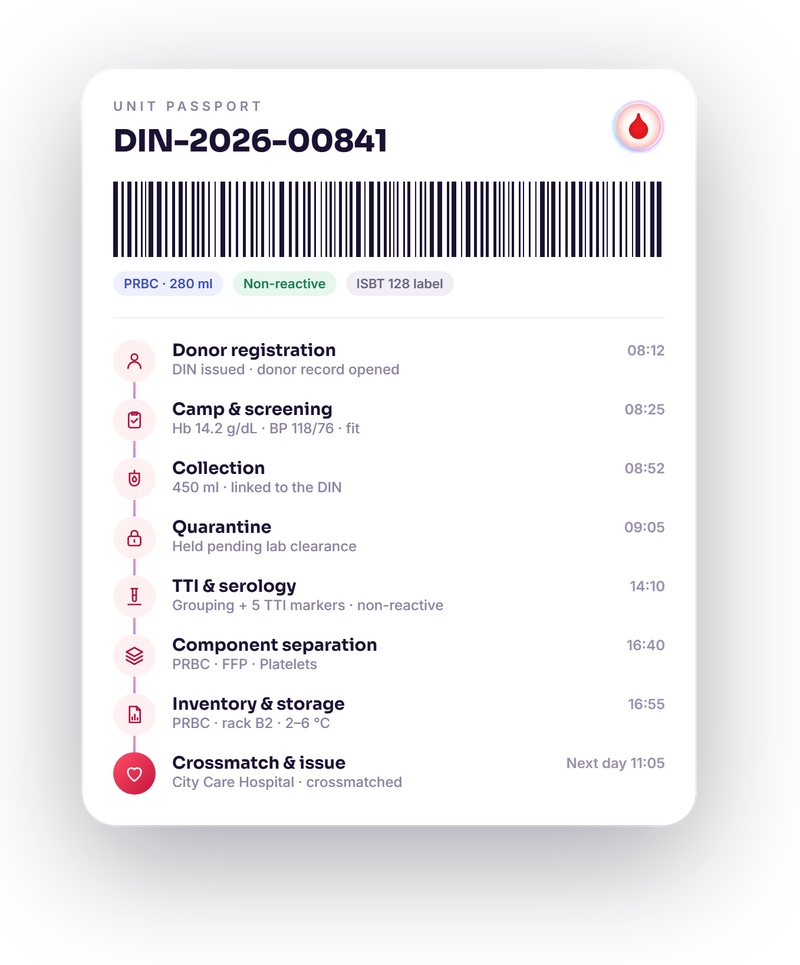
A unit of blood passes through eight distinct stages between the donor and the patient. At each one, something is recorded, and each record has to connect to the one before it.
- Donor registration. The donor's identity and history are captured and a Donor Identification Number (DIN) is issued. Everything after this hangs off the DIN.
- Camp & screening. The pre-donation check: haemoglobin, blood pressure, weight, questionnaire, deferral rules. A deferral recorded here must stop that donor being bled elsewhere.
- Collection. The bag, its segments and its sample tubes are labelled with the same DIN. This is the moment the physical blood and the digital record become one thing.
- Quarantine. The unit is held and must not be issued until testing clears it.
- TTI & serology. Mandatory screening for transfusion-transmissible infections (HIV, hepatitis B, hepatitis C, syphilis and malaria), plus blood grouping and antibody screening. A reactive result has to reach every component from that donation.
- Component separation. One bag becomes two or three: red cells, plasma, platelets. Each component gets its own product code, but all of them must still point back to the same DIN.
- Inventory & storage. Each component sits at its own temperature with its own expiry. Moves between refrigerators, freezers and partner banks are all part of the trail.
- Crossmatch & issue. The unit is matched to a named patient and issued. This is where haemovigilance follow-up begins.
Where paper breaks the chain
Most blood centres already record every stage. The trouble is that each stage is recorded in a different place: a donor register, a camp sheet, a TTI register, a component register, a stock book, an issue register. The chain exists, but a person has to rebuild it by matching numbers across books. The chain breaks in predictable places:
- Transcription. Every time a unit number is copied by hand from one register to another, there's a chance of a wrong digit. One wrong digit is enough to lose a unit.
- The split. Component separation turns one record into several. If components are logged separately and the link to the parent donation is loose, a lookback finds the red cells but misses the plasma.
- Handoffs between sites. A unit lent to a partner bank often leaves the lender's records at the door. Its later story sits in someone else's register.
- The last mile. The issue register records which hospital got the unit. Whether the patient's transfusion and any reaction make it back into the blood bank's records depends on a form being filled and returned.
When an auditor asks where a unit came from and where it went, the answer should already exist. Nobody should have to rebuild it.
Labels: traceable, not identifying
ISBT 128 is the international standard for coding and labelling blood products. It gives every donation a globally unique identifier and standard product codes, so a label can be read by any compliant system. That is what lets a unit keep its identity when it crosses from one blood bank's software to another's.
Traceability doesn't mean the donor's name should be on the bag. A good label carries what the clinical team needs, such as the donation number, product, blood group, expiry and donor category, while the link to the person stays inside the blood bank's records. Under India's Digital Personal Data Protection Act, 2023, that separation is also the sensible way to handle donor data.
Six questions to test your own system
Whether you use registers, spreadsheets or software, try these with a real unit number from last quarter:
- Starting from a donor, can you list every component made from their last three donations, and where each one is now?
- Starting from a patient, can you name every donor whose blood they received?
- For a single issued red cell unit, can you show its TTI results, the date of each test and who released it from quarantine?
- Can you show the storage history of a unit of plasma, including every freezer it was in?
- If a unit was lent to a partner bank, can you say what happened to it after that?
- How long did all of that take, and how many registers or files did you open?
If the answers come back in minutes from a single record, your chain is intact. If they take an afternoon and three people, it isn't broken yet, but it depends on people doing heroic work every time someone asks.
How RedHalo approaches it
In RedHalo BBMS, the DIN is issued at registration and every later step writes to the same record. That covers screening, collection, quarantine, testing, separation, storage, crossmatch and issue. Components carry their parent DIN automatically, so a reactive test result or a recall reaches all of them. The haemovigilance module maps to HvPI reporting, and labels follow ISBT 128 and carry the donor category, not the donor's name.
The aim is simple. When someone asks where a unit came from and where it went, the answer is already there.
Further reading
- ISBT 128, the international standard for the terminology, identification, coding and labelling of medical products of human origin (ICCBBA).
- Haemovigilance Programme of India (HvPI), run by the Indian Pharmacopoeia Commission.
- The Drugs & Cosmetics Rules, 1945, and the Digital Personal Data Protection Act, 2023, as they apply to blood centres and donor data.